
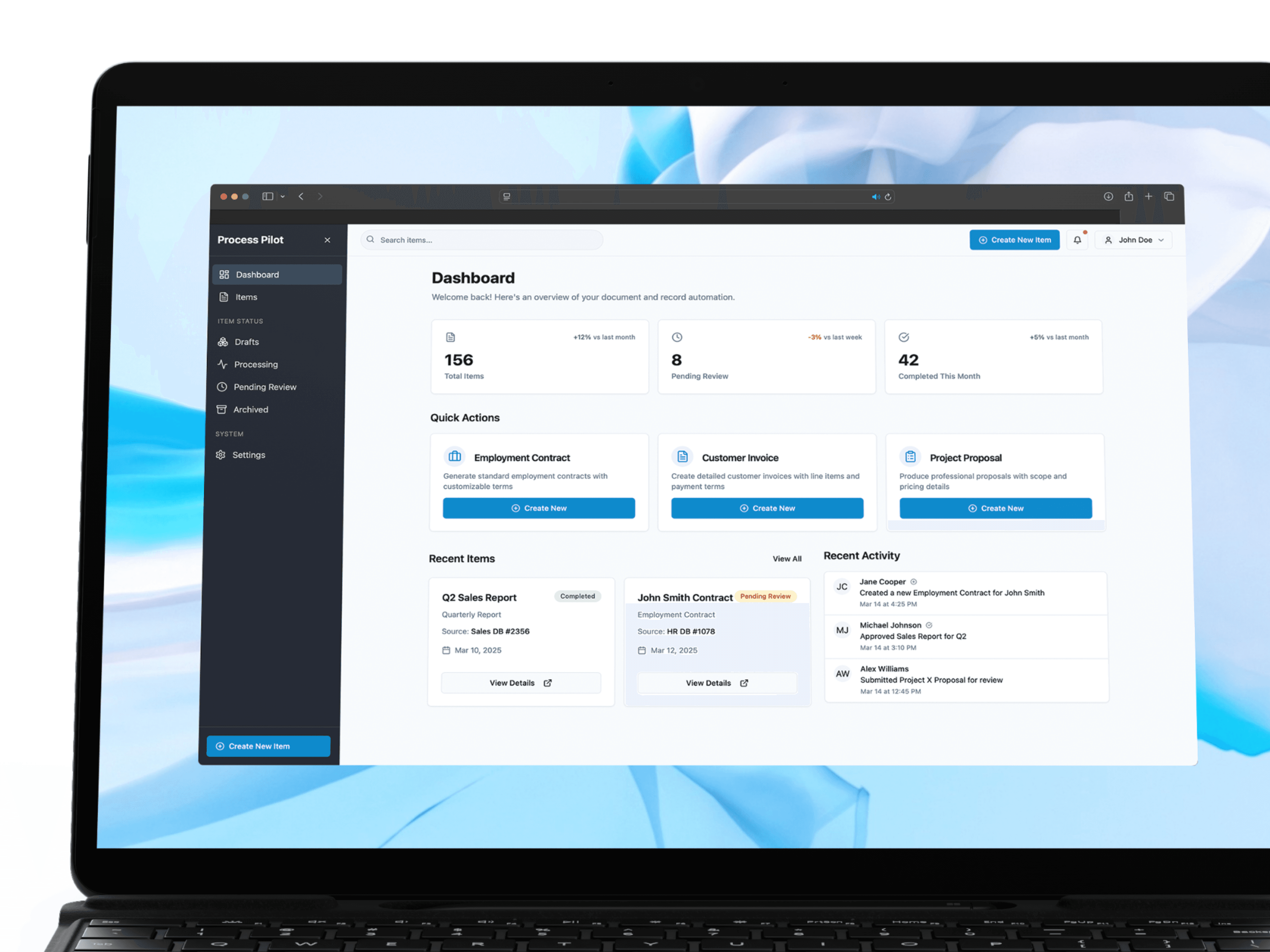
Process Pilot is a streamlined document automation platform engineered to standardise the creation of critical business records
By coupling a linear, card-based interface with intelligent "Source Record" linking, the platform allows enterprise teams to generate legally binding contracts, invoices, and complex proposals in seconds, ensuring absolute data accuracy and brand consistency.
The initial objective was to standardise documentation, but auditing the administrative workflows of HR managers and Sales Directors revealed severe systemic inefficiencies
Document Drift: Organisations struggle with outdated templates remaining in circulation, leading to critical compliance and branding errors.
The Manual Translation Penalty: Users were spending up to 40% of their time manually re-typing data (e.g., Client Names, Pricing) from project management tools directly into Word documents.
Typing Over Orchestrating: Existing workflows relied on human data entry rather than systemic data retrieval, actively introducing human error into high-stakes financial and legal documents.
Before defining the system architecture, it was necessary to deconstruct the friction of enterprise documentation
Intensive analysis of administrative workflows mapped the reality of rapid contract generation against strict legal compliance.
The Competitor Landscape Market analysis exposed that traditional document tools acted merely as digital typewriters. The opportunity lay in engineering a "headless" document creator—a system that inherently pulls existing operational data to pre-fill templates, leaving the user to only configure the variables that matter. Personas were established to balance the rapid, high-volume needs of Sales Directors with the strict template adherence and secure archiving required by HR Specialists and Operations Leads.
Bypassing traditional form-building wireframes, the process moved directly into rapid architectural prototyping
To manage the immense complexity of document variables, the interface was engineered to strictly control focus and prevent cognitive overload.
The system was architected around core pillars determined during discovery:
Linear Focus Architecture: Form fatigue is a major issue in enterprise software. All non-essential navigation was stripped away during the creation process. A centered canvas with a clear, numbered stepper (1, 2, 3) dictates the flow. Input fields are oversized, and secondary actions are hidden to maintain absolute focus.
Visual Categorisation: To distinguish between financial documents and legal documents instantly, the 'Item Type' selection utilises a highly visual, card-based UI with distinct iconography.
The "Clean Room" Aesthetic: To project stability and clarity, the visual design system relies on utilitarian sans-serif typography with generous line heights. A classic "Sidebar + Canvas" pattern ensures that overarching pipeline visibility (tracking documents from Drafts to Pending Review) is always accessible but never intrusive.
The primary advantage of generating functional prototypes is the ability to validate user behaviour in a live environment
During the initial phase, the product was designed as a standard form-builder where users typed every detail manually. However, beta testing revealed a critical flaw: the digital form was barely faster than using Microsoft Word. Users did not want a better typewriter; they wanted a data connector.
Because the architecture was adaptable, a fundamental structural pivot was executed. The core interface was re-engineered to introduce 'Source Record Integration'.
Instead of typing a client's name, the user now searches for a Project ID via a dedicated modal. The system then instantly "hydrates" the document template with all known metadata associated with that ID. In the final Review step, optional content toggles allow users to seamlessly append modular assets like "Case Studies" or "Team Bios" without needing to locate those files manually. This iteration transformed the tool from a passive writer into an active orchestrator.
Looking back at the development of Process Pilot, the critical lesson was that the best enterprise form design is one that requires the least amount of typing
The most significant takeaway was that shifting the user's role from "data entry" to "data verification" drastically improves both system trust and operational velocity. By productising the connection between project data and document generation, the "time-to-generate" for a complex proposal dropped from 14 minutes to just 2 minutes. Eliminating manual data entry fundamentally erased human error in critical fields. Future iterations will build upon this orchestration logic by introducing "Batch Processing," allowing teams to generate invoices for multiple Source Records simultaneously.