
LearnTrust is a comprehensive digital learning ecosystem engineered to bridge the gap between technical upskilling and professional credentialing
By integrating structured learning paths, algorithmic verification, and an automated CV builder into a unified platform, it transforms educational hours into tangible, verifiable career assets.
The initial objective was to address the massive skills gap in artificial intelligence, but auditing the existing e-learning landscape revealed a fundamentally broken credentialing system
The Verification Deficit: Employers inherently distrust standard course certificates because passive video completion offers zero proof of applied technical competency.
The Translation Gap: Learners experience a severe disconnect between acquiring a complex skill and successfully updating their professional portfolio, leaving them unable to prove they are genuinely "job-ready."
Cognitive Fatigue: Traditional platforms rely on endless lists of resources and heavy, distracting interface layouts that actively hinder deep technical focus during long study sessions.
Before defining the system architecture, it was necessary to deconstruct the actual value of a digital credential
Intensive insights-gathering sessions with technical hiring managers and self-taught professionals mapped the friction between independent learning and enterprise hiring requirements.
The Competitor Landscape Market analysis exposed that competitors operated merely as passive content repositories, flooding the market with generic completion badges. The opportunity lay in engineering a verifiable credentialing authority—an ecosystem where active educational progress inherently builds a trusted, public-facing portfolio. This approach satisfied both the upskiller's need for tangible progression and the hiring manager's demand for transparent, verified metrics.
Bypassing the traditional, passive wireframing phase, the process moved directly into rapid architectural prototyping
This allowed for the immediate testing of complex gamification logic within a live, token-driven interface.
The system was architected around core pillars determined during discovery:
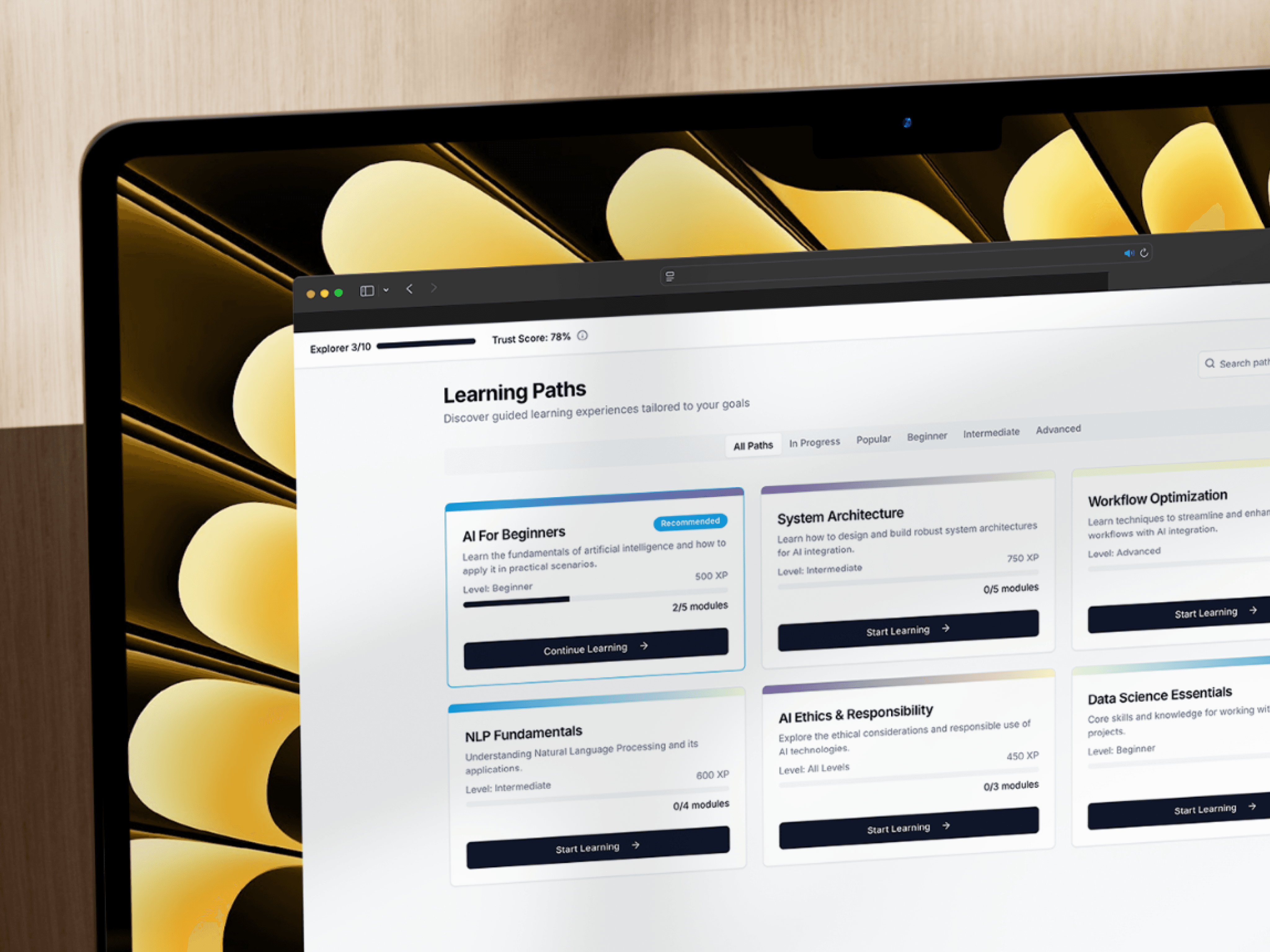
Cognitive Focus Architecture: Learning dense topics like system architecture requires mitigating visual distraction. The environment was stripped of heavy sidebars, utilising ample white space, high-contrast typography, and a muted, clinical colour palette to reduce eye strain. Progress tracking was relegated to subtle, persistent top-bar indicators to maintain total user immersion.
Algorithmic Credential Generation: The system was engineered to automatically translate mastered learning paths into dynamic, downloadable certificates detailing specific verified skills (e.g., Prompt Engineering) and software mastery.
Privacy & Portfolio Control: A persistent navigation toggle allows users to seamlessly switch their dashboard between a private learning environment and a public, verifiable portfolio open directly to technical recruiters.
The primary advantage of generating functional prototypes is the ability to validate user motivation in a live environment
The initial build mirrored traditional e-learning sites, relying heavily on video players. However, testing revealed a critical lack of engagement—passive watching did not make users feel competent, resulting in high cognitive fatigue.
Because the architecture was adaptable, a fundamental structural pivot was executed. The platform was completely re-engineered from a passive viewing experience into an active, gamified validation engine.
The introduction of a dynamic 'Trust Score' and 'XP System' meant users could no longer simply click "Next Video." They were required to complete practical exercises to earn XP, which algorithmically fed their global Trust Score. This iteration successfully transformed the product from a static library into a rigorous credentialing authority.
Looking back at the development of LearnTrust, the critical lesson was that designing an educational platform requires a rigorous balance between gamification and professional credibility
The most significant takeaway was that excessive gamification feels juvenile, while too little feels sterile and demotivating. The algorithmic 'Trust Score' struck the perfect balance—acting as a highly engaging behavioural motivator for the learner while serving as a serious, verifiable metric for the employer. Bypassing static mockups to test this mathematical logic in a live environment proved that active validation is the only way to build genuine institutional trust. Future iterations will expand on this by integrating live calendar UIs directly into the dashboard, seamlessly blending independent study with expert 1-on-1 mentorship.