
TalentFlow is a comprehensive, white-label talent acquisition platform engineered specifically for staffing agencies and headhunters
By consolidating an advanced AI-matching engine, automated messaging suggestions, and client requisition management into a single highly customisable workspace, the platform empowers agencies to streamline candidate pipelines and collaborate seamlessly under their own brand identity.
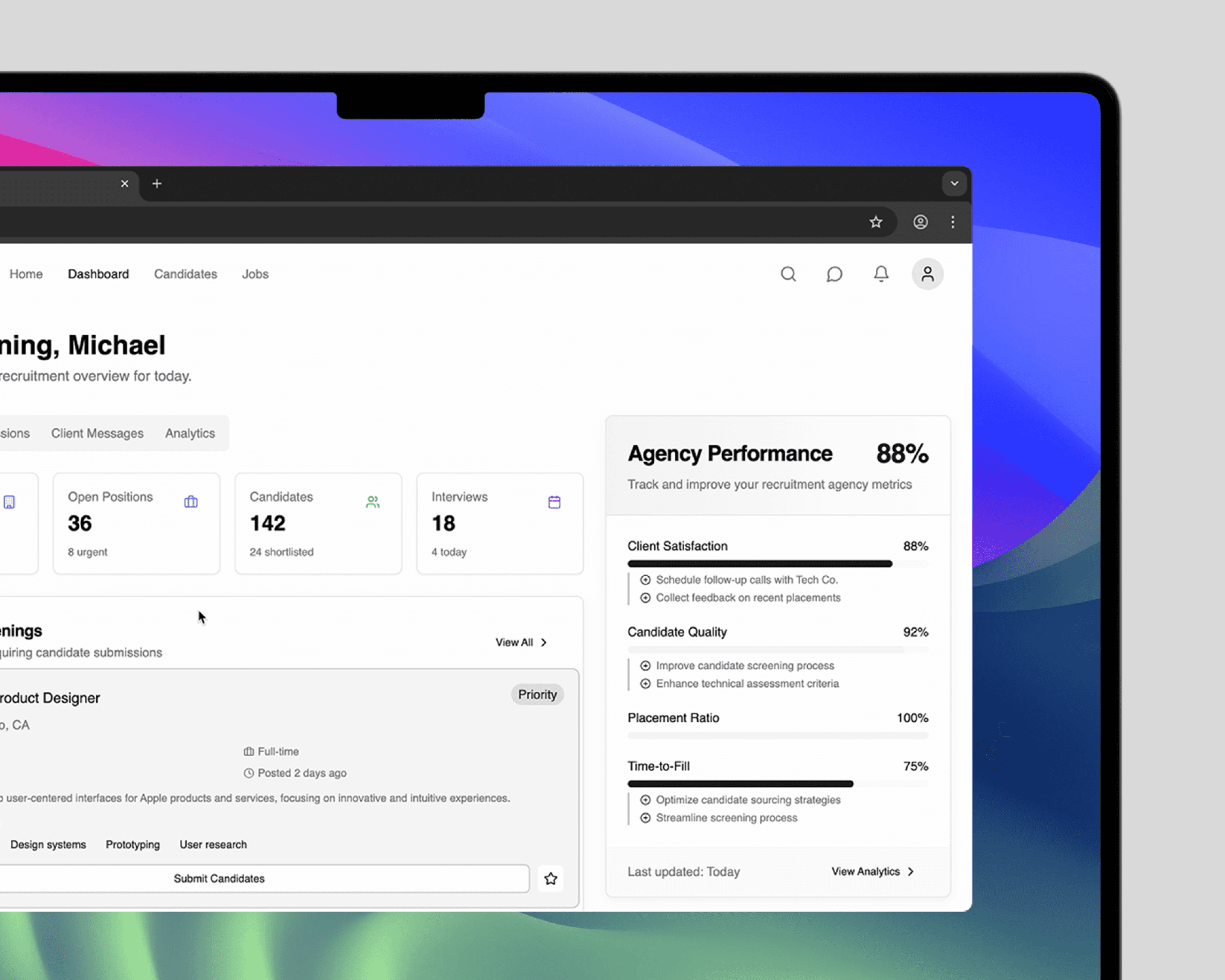
The initial objective was to serve high-volume recruitment agencies, but auditing the talent sourcing pipeline revealed severe operational bottlenecks
The Manual Sourcing Bottleneck: Recruiters were losing hours daily cross-referencing static CVs against complex client job requisitions.
Brand Dilution in Client Handoffs: Existing sourcing tools offered no white-label capabilities, forcing agencies to present candidate shortlists to clients through unbranded, third-party interfaces.
The "Black Box" Trust Deficit: Traditional keyword-matching search bars failed to provide recruiters with the necessary context, leading to a lack of trust in automated recommendations.
Before defining the system architecture, it was critical to audit the reality of modern recruitment operations
Intensive observational sessions and requirement-gathering workshops with agency directors and senior technical recruiters mapped the friction between rapid sourcing and client presentation.
The Competitor Landscape Market analysis exposed a gap in how agencies presented candidates to enterprise clients. Competitors provided robust internal databases but failed to bridge the gap to client-facing presentation. The opportunity lay in engineering a solution that leverages AI to automate the heavy lifting of candidate screening, while providing a premium, brandable interface for agency-client collaboration. Personas were mapped to balance the rapid sourcing needs of recruiters with the macro-level job tracking required by agency directors and the profile visibility needs of premium candidates.
Bypassing the slow, traditional wireframing phase, the process moved directly into rapid architectural prototyping
This allowed for the immediate testing of complex data relationships across a live, token-driven interface.
The system was architected around core pillars determined during discovery:
High-Density Scanning Architecture: To handle dense candidate histories, the workspace relies on a modular, card-based UI utilising collapsible accordions for client requirements and visually distinct pill-shaped tags for key skills. A high-contrast, monochromatic typographic hierarchy ensures critical metrics are readable in a fraction of a second.
Token-Driven White-Label System: To act as a blank canvas for an agency's custom branding, the visual system had to be exceptionally clean and neutral. Dynamic UI components were built as reusable variants, ensuring the interface could instantly adapt to custom styling without breaking accessibility ratios.
Intelligent Outreach Automation: A unified messages panel integrates AI-generated, highly personalised outreach templates based on the candidate's specific portfolio and the client's exact requirements.
The primary advantage of generating functional prototypes is the ability to validate the core business proposition early
During initial conceptual testing, the design leaned heavily toward a traditional job board layout where recruiters would manually filter through databases. However, testing revealed a critical behavioural insight: recruiters fundamentally distrusted standard "keyword matching" search bars and generic match percentages.
Because the architecture was adaptable, a significant structural pivot was executed. The core interface was re-engineered to feature an 'Explainable Candidate Match' module. Instead of a generic score, the UI explicitly breaks down the AI's reasoning, displaying granular confidence bars for 'Skills Match', 'Experience', and 'Culture Fit'.
This specific iteration proved that transparently displaying how the AI arrived at its conclusion was necessary to build recruiter trust.
Looking back at the development of TalentFlow, the critical lesson was that designing for AI in recruitment requires a delicate balance between automation and human intuition
The most significant takeaway was that professional users will actively reject AI if it operates as a "black box".
By replacing manual keyword searches with holistic, explainable AI matching, the platform transformed a feature that could have been viewed with suspicion into its most trusted asset. Usability testing confirmed that granular match breakdowns provided recruiters with the exact talking points needed when presenting candidates to clients, significantly accelerating the submission process. In future iterations, exploring predictive retention analytics will further empower agencies to match candidates not just for skills, but for long-term placement success.